
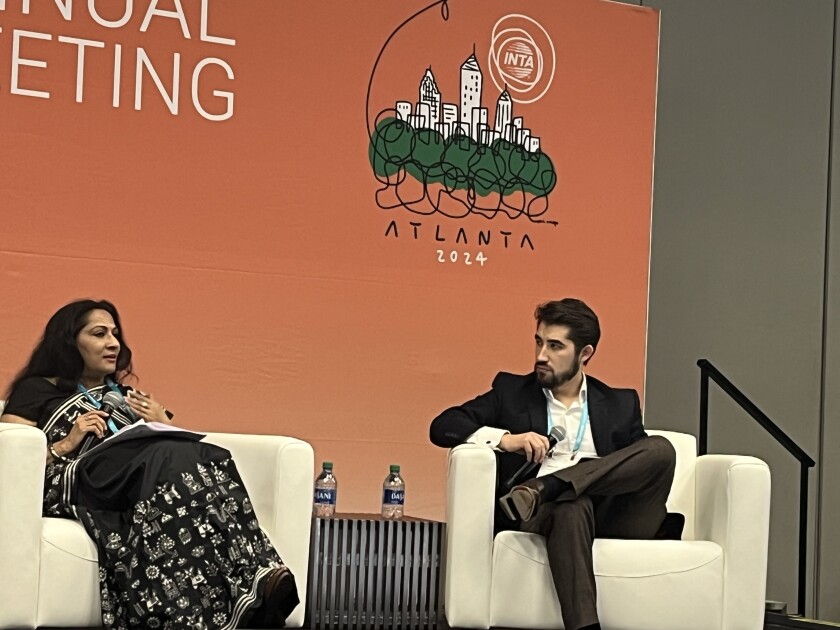
Today, May 23, is the final day of INTA's Annual Meeting for 2024, and arbitration and artificial intelligence have been among the top talking points.
Arbitration arguments
Panellists from Switzerland, the US, and India explored the ins and outs of trademark and other intellectual property arbitration in a panel session this morning.
Arbitration is a form of dispute resolution, and an alternative to litigation, where a third party issues a binding decision.
Speakers said there were many benefits to arbitration compared to filing a dispute in court.
Philipp Groz, partner at Schellenberg Wittmer in Switzerland, said a major advantage is confidentiality.
"Very often this will be a dispute between two major players in an industry and they do not want to air the dispute in the public," he said.
He added that parties can choose their arbitrators. For example, parties could pick someone with a background in trademarks or in the specific area of business that they're in.
Stewart Mesher, partner at K&L Gates in Texas, added that US federal courts – and courts in many other countries – tend to be busy.
"The very busy [federal] courts may not move as quickly as a privately paid arbitrator," he said.
He added that costs of arbitration can also be lower depending on how the parties structure their arbitration agreements.
Winning tactics
That said, he argued that not every aspect of arbitration is guaranteed to be confidential.
He said he often files arbitration decisions in a federal court. The court will then confirm the decision publicly.
He does this to show people that he won and to send a message to others who might have contractual disputes with his clients.
There are also some pitfalls that parties have to consider when drafting arbitration clauses in contracts, according to speakers.
Mesher at K&L Gates warned audience members to make sure they are specific enough.
He noted that if parties don't specify what arbitrators can and cannot decide then the arbitrators will decide themselves which issues they can rule on.
But Groz at Schellenberg Wittmer argued that being too specific can also backfire.
He said sometimes parties include issues that they don't need to consider in arbitration provisions, which can end up making things more complicated.
"If you decide to deviate from a model arbitration clause, seek counsel from a person experienced in arbitration because otherwise you will end up spending a lot of time and money trying to correct mistakes that were made in the agreement," he said.
He added that some parties have agreed unreasonable time limits.
They might mandate that an arbitrator should issue a decision within 30 days which is generally unrealistic, he said.
Efraín Olmedo, counsel at Santamarina + Steta in Mexico, who moderated the panel, asked about what kind of qualifications parties should seek in an arbitrator.
Girija Krishan Varma, an international certified mediator based in India, said that picking an arbitrator could depend on the matter at hand.
"If it's a highly technical issue, then it may be advisable to have an arbitrator who understands that," she said.
However, she added that someone who understands IP generally should be qualified to handle most IP matters.
Rocket man
Away from arbitration, AI has been continuing to provide plenty of talking points for delegates.
Lawyers have had to grapple with how the technology can bring opportunities for their business but also the impact it may have on staff, particularly junior lawyers.
Plenty of sessions this week have touched on or delved into the technology.
In one of them, held today, May 22, speakers focused on the AI tools available to assist attorneys in their practice.
Darren Meale, partner at Simmons & Simmons in London, spoke about the Rocketeer platform he created. Rocketeer is an AI tool that provides a likelihood of confusion assessment between two trademarks.
Meale said the tool is based around “most of the work we do as trademark lawyers” but that it does it better.
The tool predicts the outcome of a conflict between word marks at both the EUIPO and UKIPO and provides hundreds of examples of supporting case law.
In four seconds, the platform analyses more than 10,000 previously reported decisions to make its prediction and backs this up with hundreds of case law examples.
Meale noted that asking a colleague or junior associate to perform a task on that scale is simply unfeasible.
He added: “A lot of the time, due to budgets and time constraints, lawyers are often making likelihood of confusion assessments based on our gut feeling.
“The reality of modern practice is that there is often not the time or budget to go through extensive clearance searches and finding supporting case law.”
Nevertheless, he was quick to point out that Rocketeer is not something that should be viewed as a replacement for lawyers.
“We are not talking about a replacement tool, we are talking about something that should make us better at doing our jobs,” he added.
He noted that lawyers should still perform their own assessments and the results generated by Rocketeer should merely act as a thinking tool.
While panellists seemed confident that AI will not replace swathes of jobs just yet, they did warn lawyers to remain vigilant.
Barclay Blair, managing director for AI product innovation at DLA Piper in the US, said: “It may not replace jobs for now but it will certainly replace lots of the things you write on your time sheets”.
Question of the day
Today, as the conference winds up and delegates prepare to fly back to various parts of the world, we asked attendees what their highlight of the conference had been.
Eric Tzeuton, CEO of Soteryah IP in France, said meetings were his best moments. He found these helpful for improving his practice.
“[There were] interesting people to meet and to come into contact with,” he said.
Natalia Gulyaeva, partner at Hogan Lovells in Germany, said discussions about the importance of arbitration, such as at this morning’s arbitration panel was a highlight.
“We always want to resolve IP disputes efficiently and sometimes alternative dispute resolution matters give much better results than lengthy and cost-consuming litigation,” she said.
Looking ahead
That's it for the INTA Annual Meeting this year.
It's been a great week. We've had many, many meetings, attended illuminating panel sessions, and enjoyed receptions and parties in and around Atlanta.
Attendees are now heading to the Mercedes-Benz Stadium for the grand finale.
Next year’s Annual Meeting, as had been expected, will be held in San Diego from May 17 to 21. We hope to see you there!





