Breaking: UPC chief urges EU to rethink SEP plan

Managing IP is part of Legal Benchmarking Limited, 1-2 Paris Gardens, London, SE1 8ND

Copyright © Legal Benchmarking Limited and its affiliated companies 2026

Accessibility | Terms of Use | Privacy Policy | Modern Slavery Statement

Breaking: UPC chief urges EU to rethink SEP plan

KerstinJorna.jpg
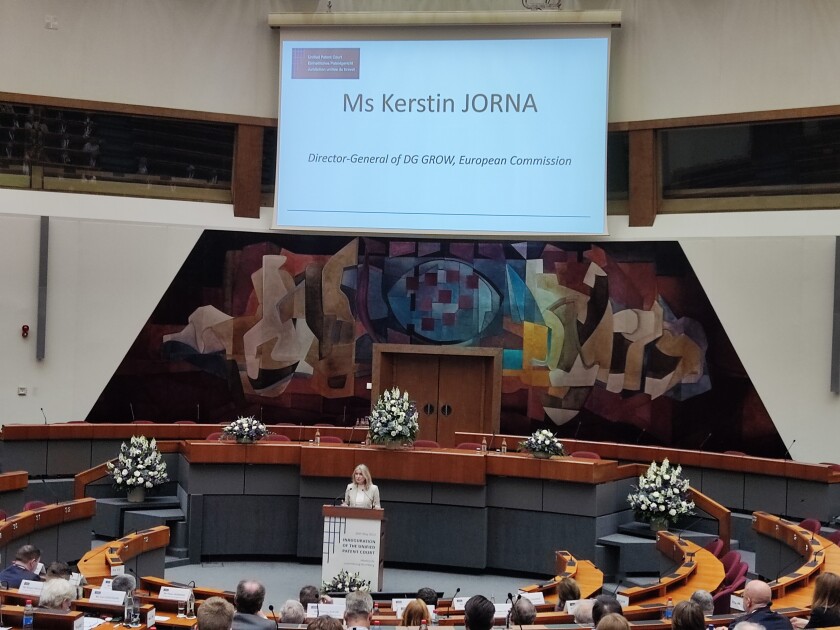
Kerstin Jorna, head of DG Grow, speaking at the UPC inauguration in Luxembourg today

Klaus Grabinski told delegates at a UPC inauguration event that the proposed SEP regulation would limit access to justice

The most senior judge of the Unified Patent Court has sharply criticised the European Commission’s draft standard-essential patent reforms.

Klaus Grabinski, chief judge of the UPC Court of Appeal, said he feared the draft SEP regulation, published last month, was not currently compliant with the EU Charter of Fundamental Rights.

Speaking at the formal inauguration of the UPC at the Hémicycle in Luxembourg today, May 30 – which Managing IP is attending – Grabinski said he felt obliged to comment on the plan.

The German judge said he was concerned that SEP owners would have to register their patents at the EUIPO before they could bring an infringement action at the UPC.

“I fully support the commission’s aim to enhance transparency, but access to justice is a core fundamental right,” he said.

Grabinski questioned why SEP owners should not be able to bring infringement actions in the EU while they could in the UK and China.

Under the commission’s draft regulation, patent owners would have to register their SEPs at the EUIPO, which would carry out essentiality checks and determine fair, reasonable, and non-discriminatory (FRAND) royalties.

They would be unable to bring infringement actions for those patents until the end of that process, which could take up to nine months.

But SEP owners would still be able to seek “provisional injunctions of a financial nature” while the EUIPO process was ongoing.

SEP owners had seen the UPC as an attractive option, mainly thanks to the prospect of Europe-wide injunctions.

But it’s unclear what role the new court will play in the future of global SEP litigation if the commission’s plan is realised.

“I have no doubt that the regulation will be fully compliant with the EU Charter of Fundamental Rights after it has gone through the [full] legislative process,” Grabinski added.

Kerstin Jorna, head of DG Grow – the EU body that drew up the proposal – also gave a speech but did not comment on Grabinski’s remarks.

Jorna spoke instead about the importance of intellectual property to the EU single market and encouraged all member states to join the unitary patent system.

The UPC will open on Thursday, June 1.

more from across site and SHARED ros bottom lb

More from across our site

Monetisation is standing at the forefront of patent development, and one firm says AI is increasingly being deployed
Data centres are being built across the US, prompting patent disputes, but Texas’s thriving tech industry and patent-ready courts make the state particularly ‘ripe’ for litigation
Carpmaels & Ransford is set to bolster its UK attorney team with the appointment of Simmons & Simmons’s head of IP in the UK
Updates on Nokia’s licensing strides and a surge in patent activity around battery recycling in Australia were also among the top talking points
To mark International Day Against Child Labour, Matteo Amerio at Corsearch says the people inside businesses who can identify counterfeiting risks must be given the tools and authority to act
With genuine equity at IP firms becoming rarer, securing partnership is harder than ever, but increased transparency is also making climbing the ladder more predictable
Yossi Sivan explains how Israeli judgment is a pro-brand owner departure from the norm and why it sends a strong message that corporate structures are not always a shield
Halim Shehadeh, group CEO of IP firm CWB, says that in the rush to discuss what AI can do, IP firms are overlooking the more important question of whether they are ready
Caitlin Heard, who formally joined the firm from CMS last month, says she is excited by the ‘energy’ of the London office
Ranjna Mehta-Dutt, who moved to Chadha & Chadha after 25 years at Remfry & Sagar, says the firm plans to expand its life sciences practice through targeted recruitment and dedicated teams for bigger clients
Gift this article