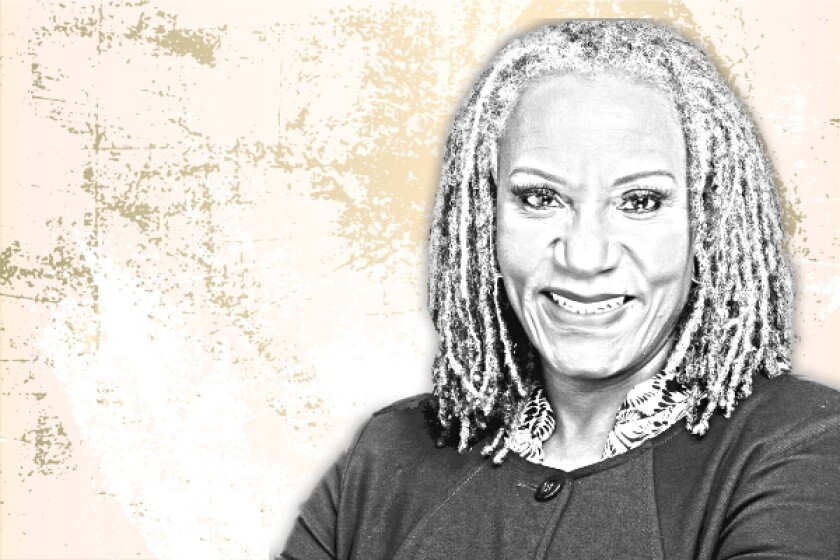
Corner office podcast: Phyllis Turner-Brim, chief IP counsel at HP

Managing IP is part of Legal Benchmarking Limited, 1-2 Paris Gardens, London, SE1 8ND

Copyright © Legal Benchmarking Limited and its affiliated companies 2025

Accessibility | Terms of Use | Privacy Policy | Modern Slavery Statement

Corner office podcast: Phyllis Turner-Brim, chief IP counsel at HP

Phyllis Turner-Brim

Phyllis Turner-Brim talks about her career, the need for balance in intellectual property policy and her passion for diversity and inclusion

Phyllis Turner-Brim has had a varied career, having worked as an intellectual property lawyer for a lot of different companies over the past 30 years, including BP, Walmart, Intellectual Ventures, Starbucks, and now HP.  

In Managing IP’s newest Corner office podcast, the Texas-based deputy general counsel and chief IP counsel at the US computer and printer maker says one of the main things she has learned from her different experiences is it’s important to maintain a balanced IP ecosystem.

“I’m a big fan of balance,” she says. “In my career, I’ve been on every side of the IP rubric, so to speak. I’ve been a licensor and a licensee, a buyer and a seller, an acquirer and a divestor, and an enforcer and enforced against.

“Any system that stacks the deck too much in any one favour is not good – we need balance across the board.

“Why? Because most companies, including HP, play across the entire ecosystem. For me to say we should 100% do away with non-practising entities – and I was at Intellectual Ventures for a long time – is not a valid business model,” she adds.

Turning to the topic of diversity and inclusion, Turner-Brim says that if she had to grade the IP community, she’d give it a D minus.

“Of course, we’re doing a podcast and what the people listening to this may not be aware of is that I’m an African American woman,” she says. “That means I’m the rarest of birds in the aviary of IP.

“There are very few – if any – black women, other than myself, who are chief IP counsel at Fortune 50 or 100 companies, and very few at tech companies.

“African American attorneys make up about 1% of patent attorneys, which is far below the representation in the population and even among those with STEM backgrounds.”

She continues, however: “The community doesn’t get an F, because it’s made a lot of progress with women. I have more and more female colleagues and those who identify as women every day.”

Turner-Brim also spoke about her responsibilities at HP, her views on standard essential patents and what could be done to enable further progress on diversity and inclusion in the IP space.

Here’s the podcast:


more from across site and SHARED ros bottom lb

More from across our site

The parties have agreed on a court-guided settlement covering Pantech’s entire SEP portfolio, marking a global first
The introduction of Canada’s patent term adjustment has left practitioners sceptical about its value, with high fees and limited eligibility meaning SMEs could lose out
With the US privacy landscape more fragmented and active than ever and federal legislation stalled, lawyers at Sheppard Mullin explain how states are taking bold steps to define their own regimes
Viji Krishnan of Corsearch unpicks the results of a survey that reveals almost 80% of trademark practitioners believe in a hybrid AI model for trademark clearance and searches
News of Via Licensing Alliance selling its HEVC/VCC pools and a $1.5 million win for Davis Polk were also among the top talking points
The winner of a high-profile bidding war for Warner Bros Discovery may gain a strategic advantage far greater than mere subscriber growth - IP licensing leverage
A vote to be held in 2026 could create Hogan Lovells Cadwalader, a $3.6bn giant with 3,100 lawyers across the Americas, EMEA and Asia Pacific
Varuni Paranavitane of Finnegan and IP counsel Lisa Ribes compare and contrast two recent AI copyright decisions from Germany and the UK
Exclusive in-house data uncovered by Managing IP reveals French firms underperform on providing value equivalent to billing costs and technology use
The new court has drastically changed the German legal market, and the Munich-based firm, with two recent partner hires, is among those responding
Gift this article
