
Judge Alan Lourie: An evolving IP landscape

Managing IP is part of Legal Benchmarking Limited, 1-2 Paris Gardens, London, SE1 8ND

Copyright © Legal Benchmarking Limited and its affiliated companies 2026

Accessibility | Terms of Use | Privacy Policy | Modern Slavery Statement

Cookies Settings

Judge Alan Lourie: An evolving IP landscape

Lourie Alan 100

During his lunchtime keynote speech, Judge Alan Lourie discussed the changes that he has witnessed during his career


Lourie_Alan
Judge Alan Lourie

One of the biggest developments has been the split in how various industries approach IP rights.

“When I was in industry, all companies involved in science and technology and virtually all patent lawyers were in favor of a strong patent system,” he said. “While the pharma companies relied on their patents for exclusivity, the GEs, Bell Labs and IBMs, even if they used their patents differently, were all active in arguing for a strong patent system. Although I can’t speak for today’s science and technology companies, we see amicus briefs filed in our en banc cases with what some may call a pro-patent/anti-patent division among companies.”

Lourie said that AIPLA members need to weigh in on this debate and share their expertise. “As practitioners your members know more about what the law should be than any court, and you should make your voices heard,” he urged.

Judge Linn and Committee of the Year honored!
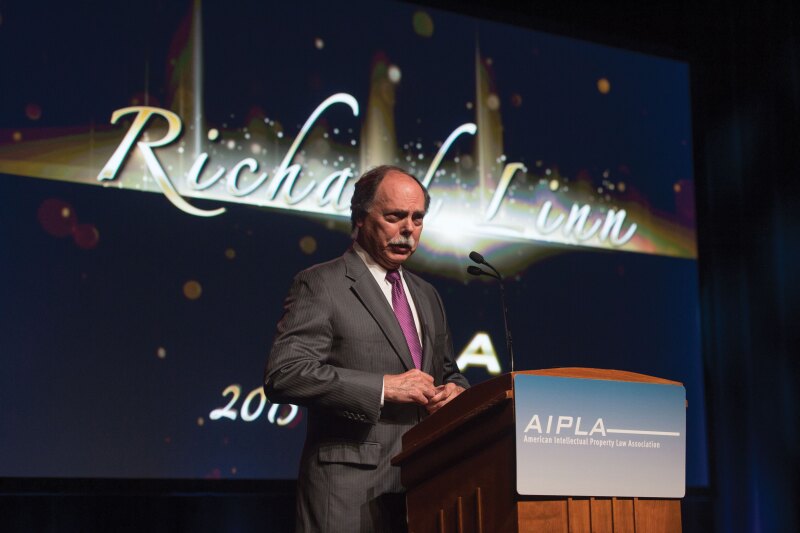
Linn Richard
AIPLA TS committee

AIPLA President Sharon Israel opened up this year’s Annual Meeting by announcing two awards. The first was the award for Committee of the Year, which went to the Trade Secret Law Committee. The Committee’s chair, John Marsh of Hahn Loeser & Parks, accepted the award.

The second was the AIPLA Excellence Award that went to Judge Richard Linn of the Federal Circuit. In a video introduction former Chief Judge Paul Michel noted Judge Linn was able to decide the Blackberry case without being affected by the politics and public relations. And in remarks on the stage, his colleague Judge Pauline Newman said Judge Linn was “visionary”.

“You know it’s a great day when you get to listen to your own eulogy,” Judge Linn said. He revealed he has been involved with AIPLA since 1965, when he was a student, and that his career in IP since then “has been rewarding professionally and financially – at least until I became a judge!” He added: “IP was sort of a backwater when I started, now it is the backbone of the economy.”


more from across site and SHARED ros bottom lb

More from across our site

Qantm CEO speaks to Managing IP about the business's first deal since it was acquired by a private equity firm and explains why top-tier Malaysian firm Henry Goh & Co was the group's ‘plan A, B and C’
György Pintz, founder of Pintz & Partners, talks through the challenges of founding a firm and explains why lawyers and table tennis players have more in common than you might expect
Kate Nuehring Su, partner at Marshall, Gerstein & Borun, explores a successful PTAB appeal and why the Federal Circuit reached an opposite outcome on the same doctrine
From BTS to Squid Game and kimchi to memory chips, the Korean wave is reverberating around the world and IP work is also seeing a boom, say two Yoon & Yang partners
Managing IP will host a ceremony in Kuala Lumpur on November 5 to reveal the winners
Recent lateral moves raise a bigger question for full-service firms – can patent litigation remain a strategic priority when competing practices generate larger profits?
As counterfeiters grow increasingly sophisticated, Gibson Dunn is differentiating its trademark practice through a focus on payment tracing, judgment enforcement and asset recovery
Anita Polott, who is celebrating three decades at Morgan Lewis this year, reflects on career progression, stepping into unfamiliar territory, and leadership frameworks
Technical excellence remains essential, but many firms are discovering that packaging IP with complementary practice areas can unlock new clients and a stronger competitive position
As international interest in Southeast Asia grows, Sheng Rong Tng discusses how changing client demands and the firm’s multidisciplinary model are helping it compete for complex regional mandates
Gift this article
